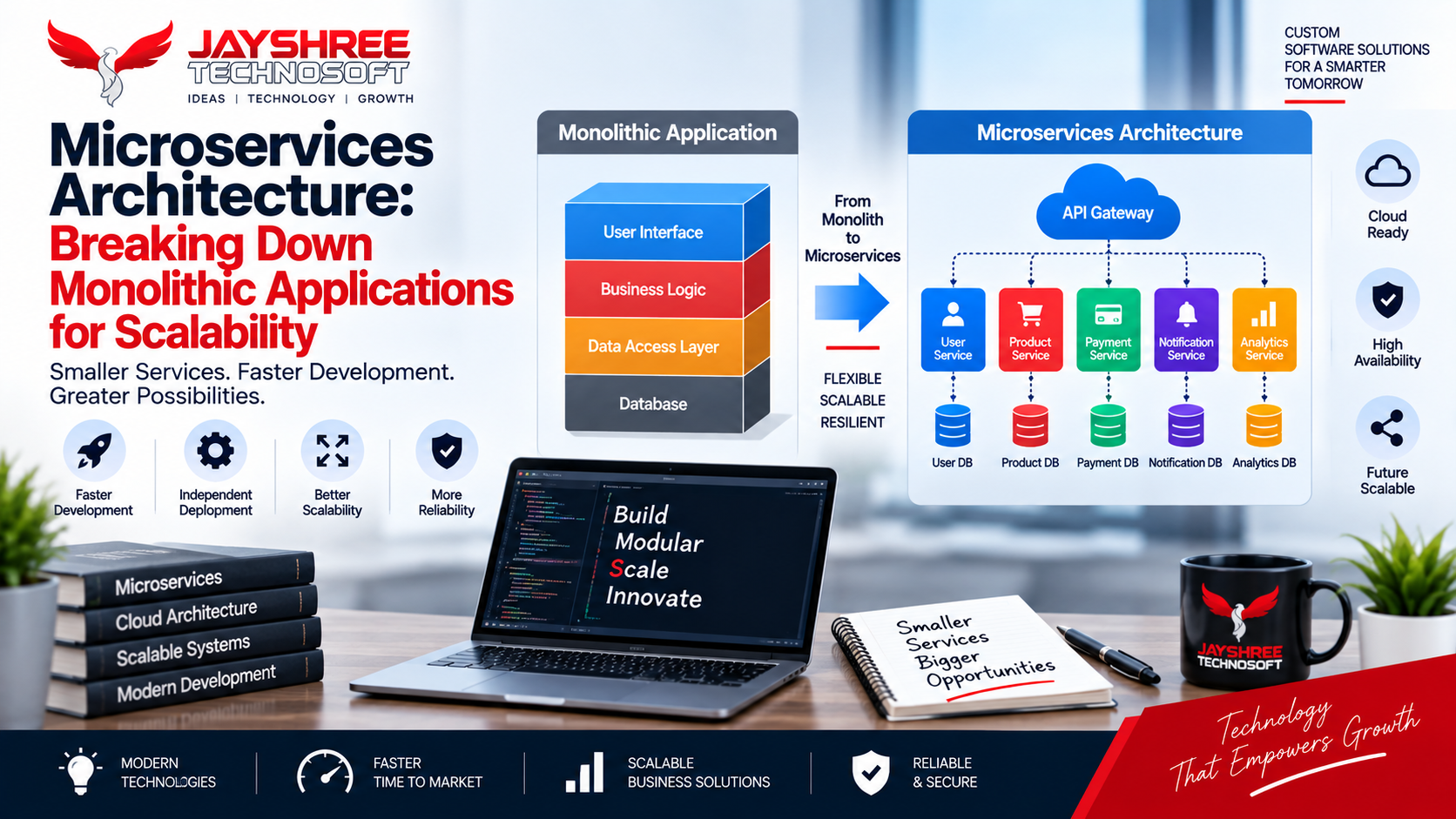
As applications grow, a single, tightly coupled codebase that once made development simple often becomes the exact thing slowing a team down — a small change in one part of the system risks breaking something unrelated, and scaling one busy feature means scaling the entire application. Microservices architecture exists to address this by breaking a monolithic application into smaller, independently deployable services — but it's a genuine trade-off, not an automatic upgrade.
Why Monolithic Applications Eventually Become a Bottleneck
A monolithic application — built as a single, unified codebase — is often the right starting choice, since it's simpler to build, test, and deploy early on. As an application and its development team grow, though, this same structure can start causing real friction: deployments become riskier because every change touches the same shared codebase, scaling requires scaling the entire application even when only one part is under heavy load, and different teams working on the same codebase increasingly step on each other's changes.
What Microservices Actually Offer
Independent Scaling
Each service can be scaled based on its own actual demand, rather than scaling the entire application to handle load on just one busy feature — a meaningful efficiency and cost advantage for applications with uneven usage patterns across different functions.
Independent Deployment
Teams can deploy updates to one service without needing to redeploy the entire application, reducing both deployment risk and the coordination overhead of releasing changes.
Technology Flexibility
Different services can, if genuinely useful, use different technologies suited to their specific function, rather than being locked into a single technology choice across the entire application.
Fault Isolation
A failure in one service is less likely to bring down the entire application, compared to a monolith where a single critical bug can affect every function simultaneously.
The Real Costs of Microservices That Get Underestimated
Microservices introduce genuine complexity that's often underestimated in the excitement of adopting a "modern" architecture: coordinating communication between services reliably, managing data consistency across services that each own their own data, and operating significantly more infrastructure and deployment complexity than a single application requires.
When Microservices Genuinely Make Sense
Microservices tend to pay off for applications with a large, complex codebase supporting multiple teams working in parallel, uneven scaling needs across different functions, and enough engineering maturity to handle the added operational complexity responsibly. For a smaller application or a team without dedicated infrastructure expertise, a well-structured monolith is often still the more practical, lower-risk choice.
A Practical Path: Gradual Migration Over a Rewrite
Rather than a risky, all-at-once rewrite, a more sustainable approach to adopting microservices typically involves identifying the specific parts of a monolithic application that would benefit most from independent scaling or deployment, and migrating those incrementally — validating the approach on a smaller scale before committing to a full architectural overhaul.
How Jayshree Technosoft Approaches This Decision
Jayshree Technosoft LLP evaluates whether a client's actual scale, team structure, and growth trajectory genuinely justify the added complexity of microservices, rather than defaulting to this architecture simply because it's currently a popular industry trend — recommending a well-structured monolith where that remains the more practical choice.
Wondering whether your application has outgrown its current architecture? Discuss your project with the team.
Recent Articles

Custom CRM & Software Solutions for Mobile & Accessories Stores: How Jayshree Technosoft Can Help

Custom CRM & Software Solutions for Property Valuation & Survey Companies: How Jayshree Technosoft Can Help
Custom CRM & Software Solutions for Accounting Firms: How Jayshree Technosoft Can Help