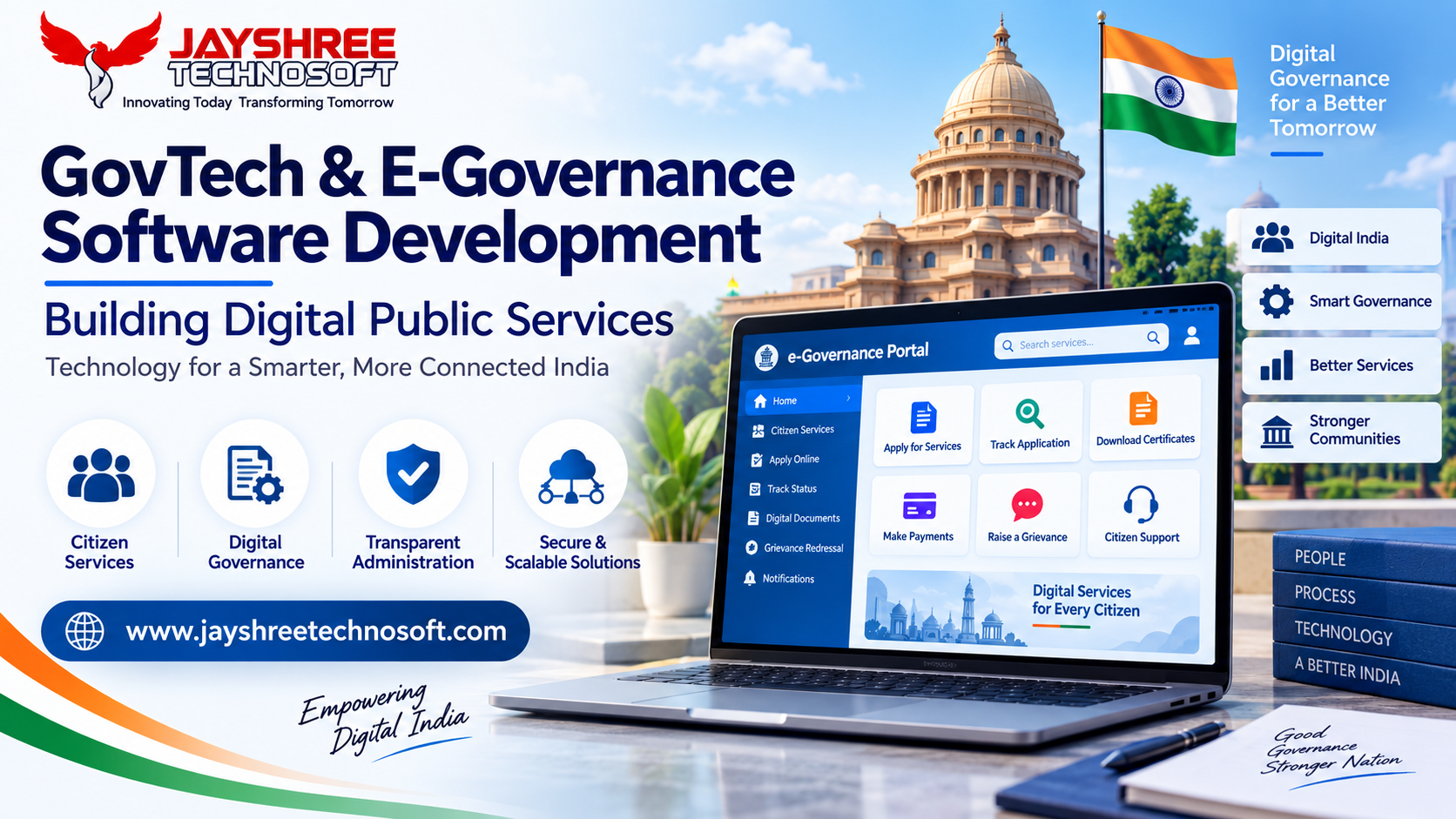
Government digitization in India has moved well beyond simple informational websites — platforms like the Government e-Marketplace now handle massive transaction volumes connecting government buyers with millions of sellers, and similar digital transformation is happening at state and municipal levels across citizen services, procurement, and public administration. Building software for this space comes with requirements that differ meaningfully from typical commercial projects.
Why GovTech Projects Demand a Different Approach
Government and public-sector software has to satisfy requirements that commercial projects often don't face to the same degree: strict security and data protection standards, the need to serve citizens across a huge range of technical literacy and device capability, multi-lingual accessibility, and long-term reliability since public services can't simply be taken offline for extended maintenance the way a commercial app sometimes can.
Core Requirements for GovTech Platforms
Security and Compliance by Design
Government platforms handling citizen data or public transactions need security built into the architecture from day one — proper authentication, encrypted data handling, and audit trails that meet public-sector compliance standards, not security retrofitted after launch.
Scalability for Unpredictable, Large-Scale Usage
Public digital services often need to handle sudden, large spikes in usage — a new scheme launch, a filing deadline — requiring architecture built to scale reliably under unpredictable demand rather than steady, predictable commercial traffic patterns.
Multi-Lingual and Accessible Design
Serving citizens across diverse linguistic and technical backgrounds means genuine multi-language support and accessible design aren't optional extras — they're core requirements for a platform meant to actually serve the public it's built for.
Interoperability With Other Government Systems
GovTech platforms frequently need to integrate with other government databases and systems — identity verification, payment systems, existing departmental records — requiring careful, secure API design rather than a fully standalone application.
Transparency and Auditability
Public sector platforms, particularly those involving procurement or public funds, need built-in transparency and audit capability, allowing oversight bodies to verify that processes are being followed correctly.
Why This Space Increasingly Uses Open, Modern Architecture
Recent large-scale government digital platforms have moved toward multi-tenant, open-API, cloud-neutral architecture — designed to be scalable, interoperable, and not locked into any single technology vendor. This reflects a broader shift in how public-sector technology projects are being approached, prioritizing long-term flexibility and vendor independence over quick, proprietary builds.
Why This Space Rewards Careful, Experienced Development
GovTech projects carry higher stakes than most commercial software — a failure or security gap in a citizen-facing government platform has real, visible public consequences. Development partners for this space need to bring genuine rigor around security, scalability, and compliance, not just standard commercial development practices applied without adjustment.
How Jayshree Technosoft Approaches GovTech Projects
Jayshree Technosoft LLP applies the same security-first, scalability-focused engineering discipline used across its enterprise and fintech work to GovTech and public-sector projects — building platforms designed for the reliability, security, and interoperability that citizen-facing digital services genuinely require.
Working on a public-sector or GovTech digital initiative? Talk to the team about your requirements.
Recent Articles
Custom CRM & Software Solutions for Mobile & Accessories Stores: How Jayshree Technosoft Can Help
Custom CRM & Software Solutions for Property Valuation & Survey Companies: How Jayshree Technosoft Can Help
Custom CRM & Software Solutions for Accounting Firms: How Jayshree Technosoft Can Help